StreamLab SXA — Low-Latency Secured Video Streaming
A low-latency, Tailscale-bound video streaming stack built around MJPEG capture, WebSocket metrics, adaptive buffering, and a browser dashboard for live telemetry.
- Role
- Developer · Streaming Stack & Telemetry UI
- Timeframe
- May 2026
- Domain
- Streaming Systems
- Status
- active
- Peak FPS
- 25 FPS
- Lowest Latency
- 3.15 ms
- Peak Bitrate
- 11.27 Mbps
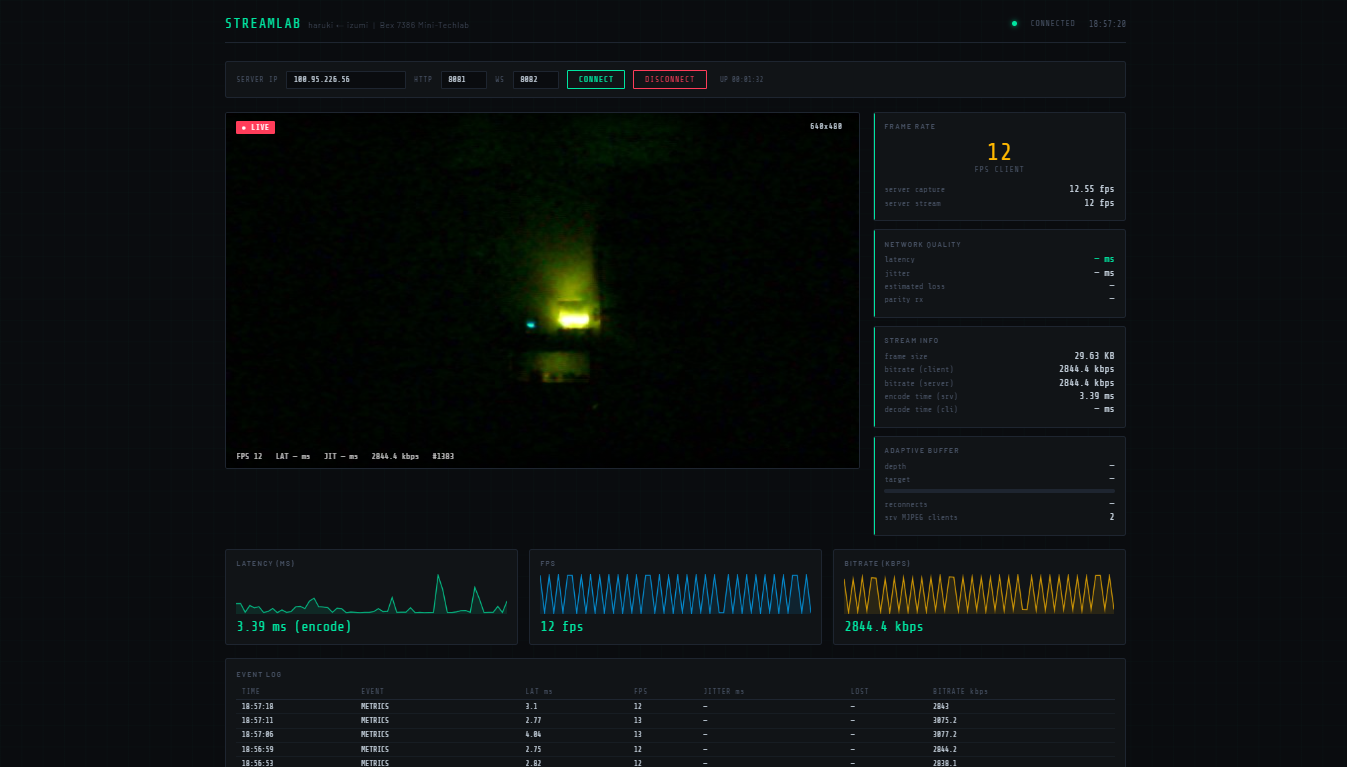
Overview
StreamLab SXA is a camera streaming system that separates capture, transport, client adaptation, and dashboard telemetry into a compact local network workflow.
The stack is designed so the server emits MJPEG frames, the client measures stream health in real time, and the browser dashboard exposes the operational state without needing a heavyweight backend.
The Challenge
The real problem was not sending video. It was keeping latency visible, frame loss bounded, and the whole pipeline reachable only through a controlled network path instead of exposing it like a fragile public toy.
Approach
- 01Implemented server-side capture and MJPEG delivery through `server.py`.
- 02Pushed live operational metrics over WebSocket so the dashboard could reflect stream health in real time.
- 03Built the client around adaptive buffering, frame-gap detection, and loss estimation.
- 04Kept the services bound to Tailscale-only access to avoid broad network exposure.
Outcomes
- Delivered a measurable low-latency streaming pipeline with client and server telemetry.
- Added practical loss visibility through FEC markers, buffer tuning, and logging.
- Provided a browser dashboard for live monitoring and remote operational control.
Stack
Backend
- Python
- aiohttp
- websockets
- OpenCV
Client
- Python
- requests
- NumPy
- Adaptive buffer
Interface
- HTML
- CSS
- JavaScript
- Browser dashboard