StaySafeX2 Solo — Gamma Radiation Detector Replica
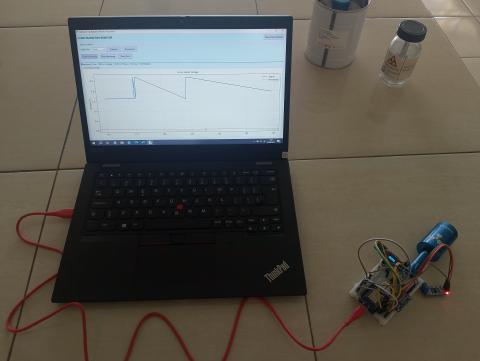
A cost-effective gamma radiation detector replica built with a BPW34 photodiode, ADS1115, and Wemos D1 Mini, combining pulse detection, dose accumulation, and live Python-based visualization.
- Role
- Developer · Sensor Electronics & IoT Visualization
- Timeframe
- Jun 2025
- Domain
- Instrumentation
- Status
- archived
- Analog Output
- 2.57–2.68 V
- Dose Step
- 0.001 µSv/pulse
- Count Rate
- 15–19 CPM
Overview
This project replicates a gamma radiation detector using a BPW34 photodiode, transimpedance amplification, and ADS1115 digitization, with Wemos D1 Mini handling the embedded workflow.
The system streams measurement data into a Python dashboard for live plotting and dose-rate monitoring, turning the detector into a practical low-cost radiation sensing platform.
The Challenge
Low-level radiation detection is noisy and unstable, so the core problem was keeping the pulse threshold and baseline calibration stable enough to avoid false counts while still capturing real events.
Approach
- 01Used a BPW34 photodiode with a TLC272-based transimpedance amplifier to convert radiation-induced signals into measurable voltage output.
- 02Added ADS1115 16-bit ADC acquisition for finer analog resolution.
- 03Implemented pulse detection and adaptive baseline calibration in the Arduino-side logic.
- 04Built a Python GUI with Tkinter and Matplotlib to visualize spikes, count rate, and dose accumulation in real time.
Outcomes
- Delivered a working low-cost detector replica for radiation monitoring experiments.
- Supported live plotting and dose accumulation through a serial-linked software pipeline.
- Created a compact embedded-plus-GUI workflow suitable for lab demonstrations and educational use.
Stack
Hardware
- BPW34 photodiode
- TLC272 op-amp
- ADS1115
- Wemos D1 Mini
Firmware
- Arduino C++
- Pulse detection
- Baseline calibration
Software
- Python
- Tkinter
- Matplotlib
- Pandas