LUMINA-GAN — Image Reconstruction and Refinement
A lightweight GAN framework for reconstructing and refining grayscale medical images, especially CT brain slices, using a U-Net-based generator, PatchGAN discriminator, and hybrid reconstruction-adversarial losses.
- Role
- Developer · Model Design & Deployment
- Timeframe
- Nov 2025
- Domain
- AI & Medical Imaging
- Status
- archived
- Input
- Grayscale CT
- Quality
- PSNR / SSIM
- Deployment
- CPU Inference
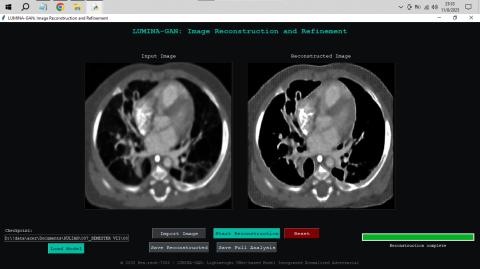
Overview
LUMINA-GAN is a compact generative adversarial framework built to reconstruct and refine degraded grayscale medical images, with a focus on CT brain slices.
The pipeline combines a streamlined U-Net-style generator with a PatchGAN discriminator and a hybrid loss design to preserve structure while improving perceptual quality.
The Challenge
Medical image restoration has to balance structural fidelity, training stability, and low compute cost. The main problem was keeping the model lightweight without wrecking anatomical detail or making inference impractical on modest hardware.
Approach
- 01Built a lightweight encoder-decoder generator with skip connections for spatial detail recovery.
- 02Used a compact PatchGAN discriminator to enforce local realism at patch level.
- 03Trained on synthetically degraded CT data with blur, compression, and intensity distortions.
- 04Added stable training controls such as fixed seeds, checkpointing, and evaluation with PSNR and SSIM.
- 05Wrapped inference in a Tkinter GUI for practical drag-and-drop use.
Outcomes
- Produced structurally coherent reconstructions from degraded CT inputs.
- Kept inference efficient enough for low-resource CPU environments.
- Delivered a usable GUI workflow for research or clinical-style review.
Stack
Model
- U-Net generator
- PatchGAN discriminator
- Adversarial learning
Training
- L1 loss
- Feature matching
- PSNR
- SSIM
Deployment
- Python
- Tkinter
- CPU inference